|
Shih-Yang (Sean) Liu I'm a Research Scientist at NVIDIA Research, where I work on efficient deep learning and reinforcement learning for LLM reasoning. I received my PhD from HKUST, where I was a member of the Vision and System Design Lab (VSDL), advised by Prof. Tim Kwang-Ting CHENG. I was also mentored by Zechun Liu, and we worked closely on model quantization. Email / Google Scholar / Twitter(X) / Github |

|
ResearchI'm interested in efficient deep learning: model compression, parameter-efficient finetuning, and more recently reinforcement learning for efficient LLM reasoning. Most of my research is about getting more out of a model per unit of compute, whether at training or inference time. Representative papers are highlighted. |
|
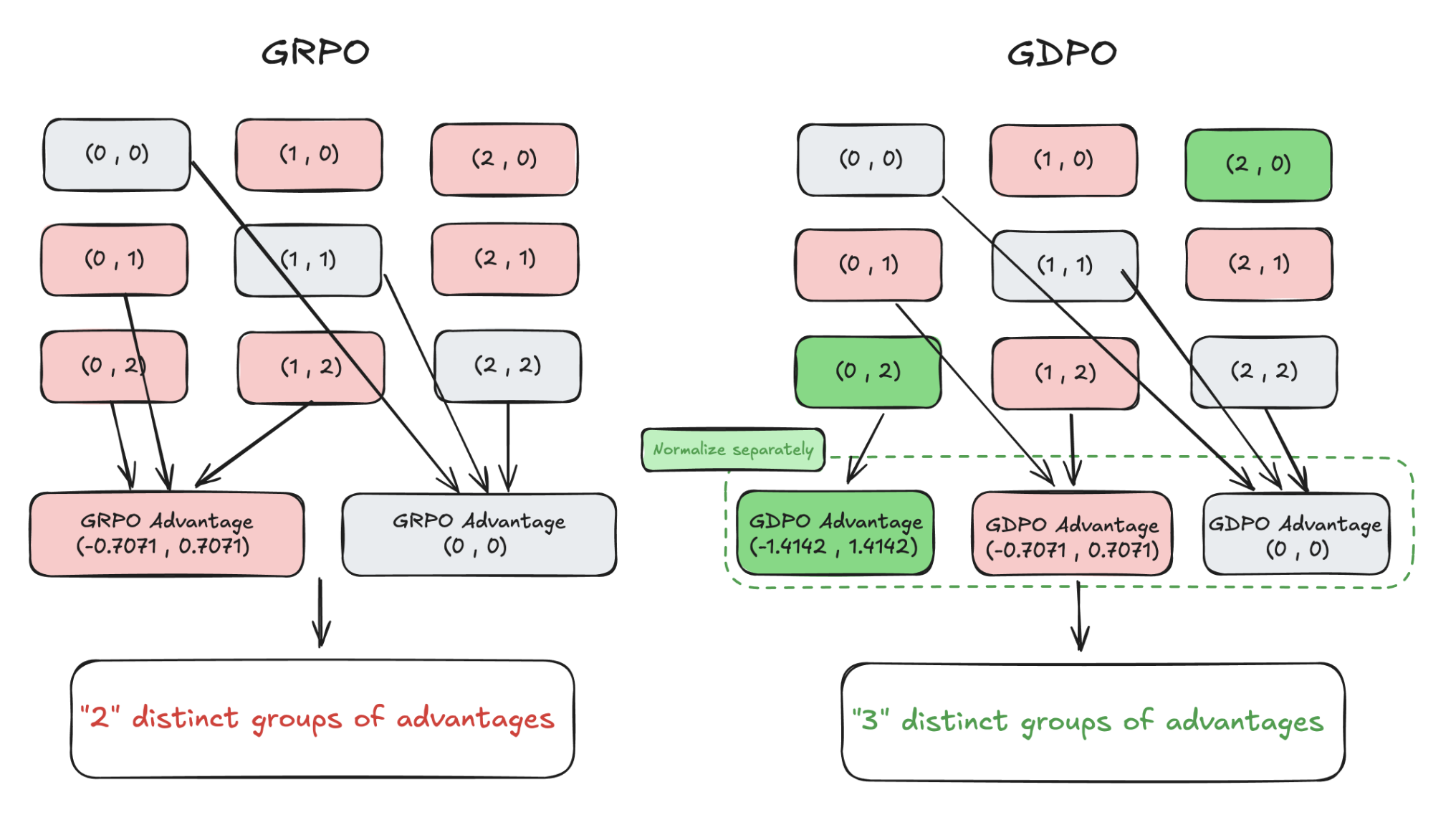
GDPO: Group reward-Decoupled Normalization Policy Optimization for Multi-reward RL Optimization
Shih-Yang Liu, Xin Dong, Ximing Lu, Shizhe Diao, Peter Belcak, Mingjie Liu, Min-Hung Chen, Hongxu Yin, Yu-Chiang Frank Wang, Kwang-Ting Cheng, Yejin Choi, Jan Kautz, Pavlo Molchanov Proceedings of the 43rd International Conference on Machine Learning (ICML), 2026 project page / arXiv / code We show that applying GRPO-style normalization to a summed multi-reward signal collapses distinct reward combinations into identical advantages, blinding the policy to per-reward progress. GDPO instead normalizes each reward independently within the group before aggregation, a drop-in replacement for GRPO that improves per-reward convergence and lifts AIME accuracy by up to 6.3%. |

|
DoRA: Weight-Decomposed Low-Rank Adaptation
Shih-Yang Liu, Chien-Yi Wang, Hongxu Yin, Pavlo Molchanov, Yu-Chiang Frank Wang, Kwang-Ting Cheng, Min-Hung Chen Proceedings of the 41st International Conference on Machine Learning (ICML), 2024 (Oral) project page / arXiv / code We presented DoRA, a new parameter-efficient fine-tuning approach, which consistently outperforms LoRA in fine-tuning LLM without incurring additional inference costs. These improvements are particularly notable for smaller ranks with 37.2% improvement over LoRA for rank 8 and 22.4% improvement for rank 4. |
|
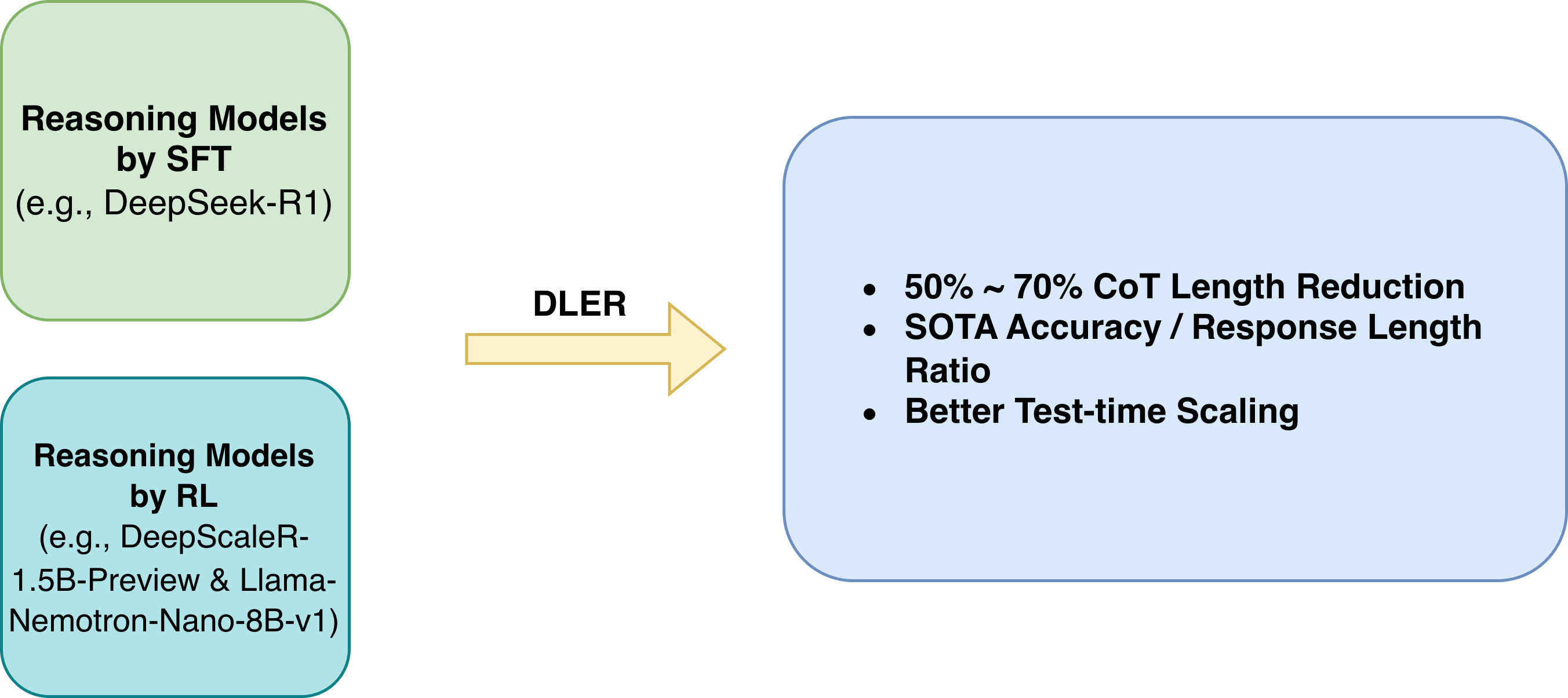
DLER: Doing Length pEnalty Right - Incentivizing More Intelligence per Token via Reinforcement Learning
Shih-Yang Liu, Xin Dong, Ximing Lu, Shizhe Diao, Mingjie Liu, Min-Hung Chen, Hongxu Yin, Yu-Chiang Frank Wang, Kwang-Ting Cheng, Yejin Choi, Jan Kautz, Pavlo Molchanov ICLR Workshop, 2026 project page / arXiv / code We show that the accuracy drop under length penalties comes from inadequate RL optimization rather than the penalty design itself, identifying advantage-estimation bias, entropy collapse, and sparse reward as the culprits. DLER combines batch-wise reward normalization, higher clipping, dynamic sampling, and a simple truncation penalty to cut chain-of-thought length by 50-70% with no loss in accuracy. |
|
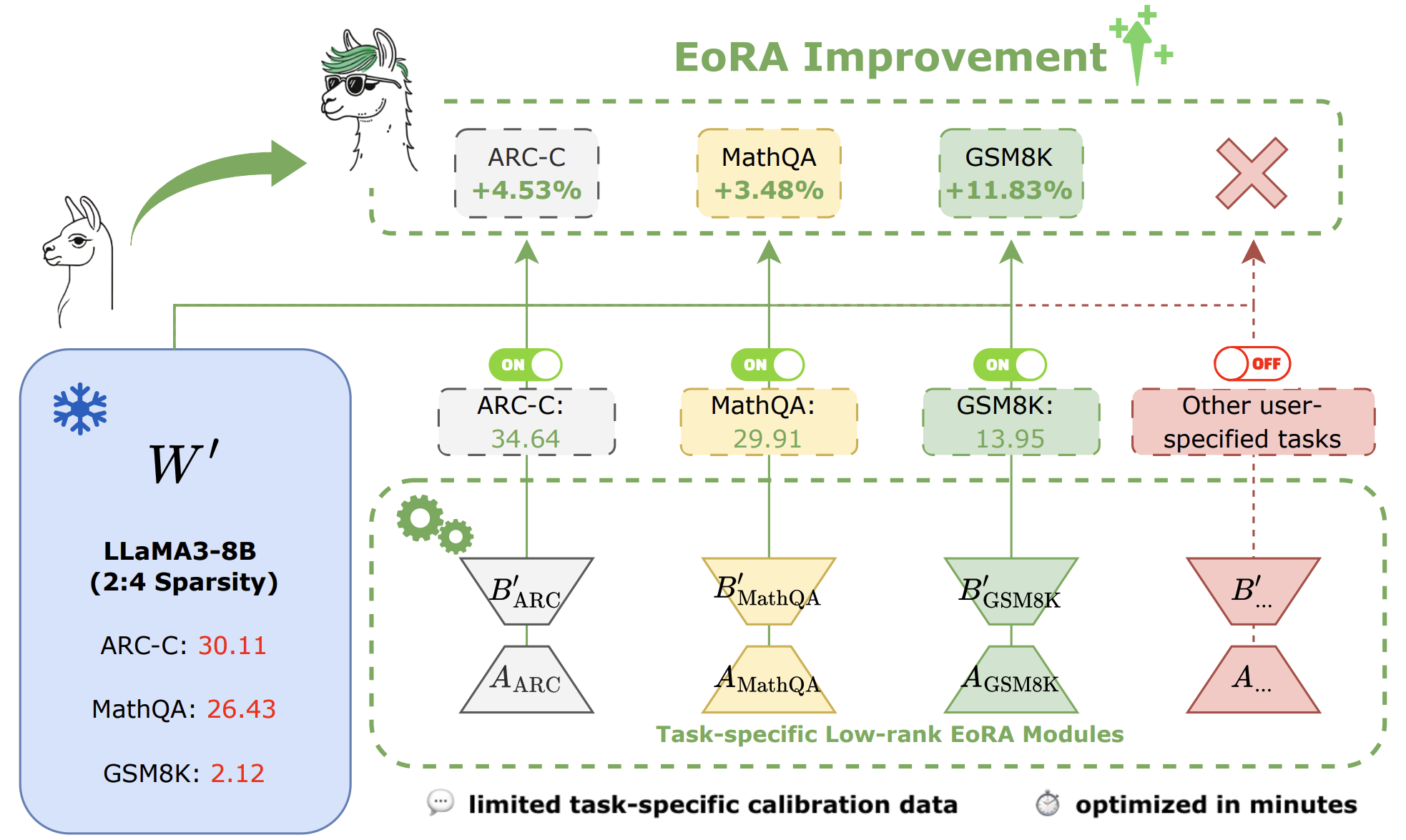
EoRA: Fine-tuning-free Compensation for Compressed LLM with Eigenspace Low-Rank Approximation
Shih-Yang Liu, Maksim Khadkevich, Nai Chit Fung, Charbel Sakr, Chao-Han Huck Yang, Chien-Yi Wang, Saurav Muralidharan, Hongxu Yin, Kwang-Ting Cheng, Jan Kautz, Yu-Chiang Frank Wang, Pavlo Molchanov, Min-Hung Chen ICLR Workshop, 2026 arXiv / code / blog EoRA augments a compressed LLM with task-specific low-rank matrices derived in the eigenspace of the compression error, recovering accuracy in minutes without any fine-tuning. It improves 3-bit LLaMA3-8B by 10.84% on ARC-Challenge, 6.74% on MathQA, and 11.45% on GSM8K over prior training-free low-rank methods. |

|
Oscillation-free Quantization for Low-bit Vision Transformers
Shih-Yang Liu, Zechun Liu, Kwang-Ting Cheng Proceedings of the 40th International Conference on Machine Learning (ICML), 2023 Paper / Code In this study, we address weight oscillation in quantization-aware training and its negative impact on model performance. We propose three techniques: statistical weight quantization (StatsQ), confidence-guided annealing (CGA), and query-key reparameterization (QKR). These techniques improve quantization robustness and accuracy in the ViT model. The proposed 2-bit DeiT-T/DeiT-S algorithms outperform the previous state-of-the-art by 9.8% and 7.7%, respectively. |

|
LLM-FP4: 4-Bit Floating-Point Quantized Transformers
Shih-Yang Liu, Zechun Liu, Xijie Huang, Pingcheng Dong, Kwang-Ting Cheng Proceedings of the 2023 Conference on Empirical Methods in Natural Language Processing (EMNLP Main), 2023 Paper / Code We introduced LLM-FP4, a novel post-training quantization framework which for the first time is capable of quantizing both the activation and weight of LLM to 4 bits without substantial loss in accuracy, outperforming previous methods by up to 13.1%. |
|
Thanks to Barron's website template. |